Steel weight in these calculators is theoretical: it is based on nominal dimensions and a nominal density, not the figure on a weighbridge ticket. Round bar and plate can be calculated from cross-section; metric rebar is treated as a solid circle in XunL’s tools; IPE and similar sections use a library mass in kg/m, so you should not invent an area from the web height.
The four worked examples below were checked on 17 November 2026 against the default inputs (or the comparison inputs stated in the text) on the steel weight calculator, steel plate weight calculator, rebar weight calculator and metal weight calculator. All of this arithmetic runs in the browser. The results are theoretical. Actual delivered mass varies with rolling and thickness tolerances, corners, coatings and the density the supplier uses; how far it moves depends on the applicable standard and the contract, and is not a fixed percentage taken from the tool copy. Settle on the supplier’s measured mass or the method named in the contract.
How steel weight is calculated
For a prismatic length:
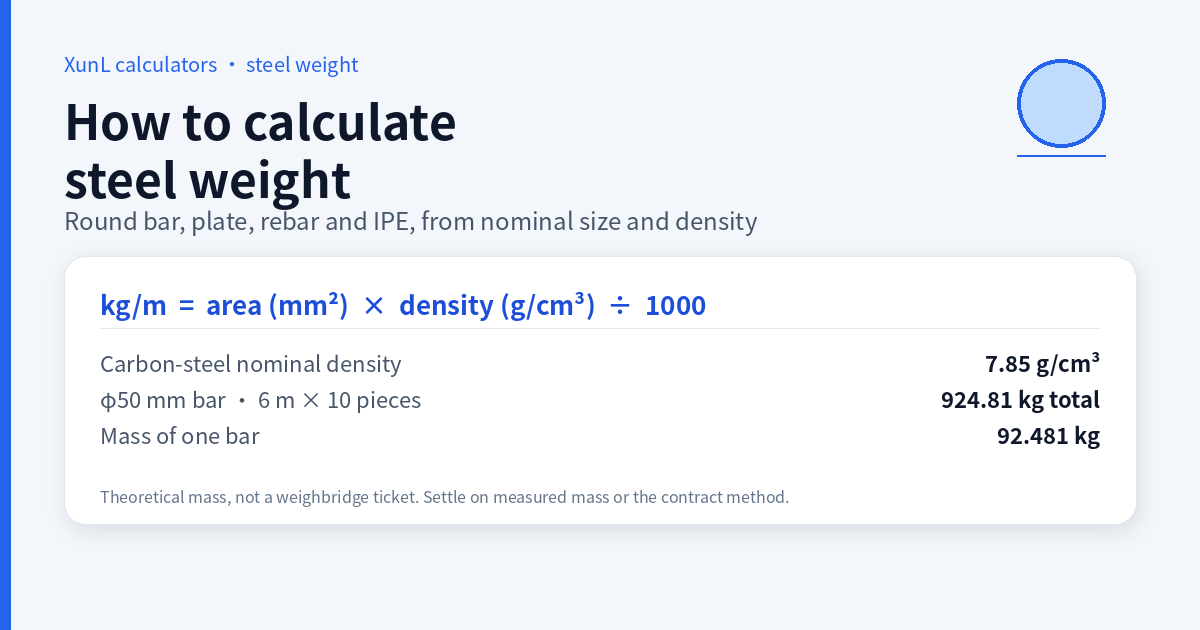
Mass per metre (kg/m) = cross-section (mm²) × density (g/cm³) ÷ 1000
Carbon steel, Q235, A36 and S235 all use a nominal density of 7.85 g/cm³ (7850 kg/m³) in these tools. That 7850 kg/m³ figure is also the nominal density Eurocode 3 (EN 1993-1-1) uses for structural steel. 304 stainless is 7.93 and 316 is 7.98; do not assume 7.85 for every steel. You can type a custom density. Multiply kg/m by length and quantity for the lot.
This is not volumetric (dimensional) weight used for freight. Here you are weighing the metal itself, not converting package volume into a chargeable weight.
Example 1: 50 mm round bar, 6 m × 10 bars
The metal weight calculator opens on carbon steel, round bar, 50 mm diameter, 6 m, 10 pieces.
- Area = π × 50² ÷ 4 ≈ 1963.495 mm² (the page shows 1963.5 mm²)
- Mass per metre ≈ 1963.495 × 7.85 ÷ 1000 ≈ 15.41344 kg/m (the page shows 15.413 kg/m)
- One bar ≈ 15.41344 × 6 ≈ 92.4806 kg (the page shows 92.481 kg)
- Ten bars ≈ 924.806 kg (the page shows 924.81 kg)
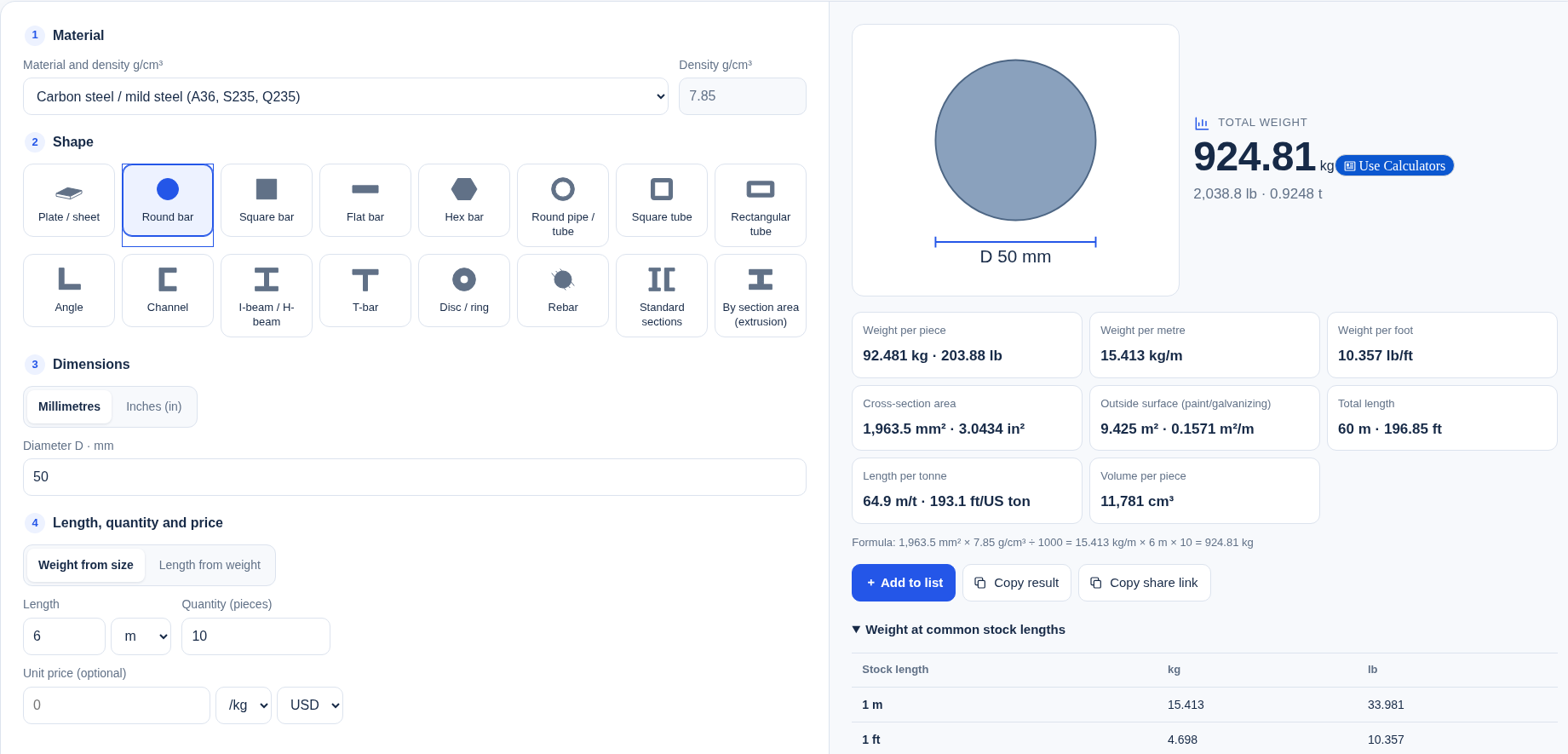
The calculator multiplies unrounded intermediates (the same is true of the area) and only then applies the display rule: 1 decimal place when the absolute value is at least 1000, 2 when it is at least 100, and 3 when it is at least 1. Do not reconstruct the bar mass from the rounded 15.413 × 6; that product is 92.478, not the 92.481 shown on the page.
Example 2: 10 mm steel plate, 1500 × 6000 mm, 5 plates
The steel plate weight calculator defaults to carbon steel (mild steel, often searched as MS plate), 1500 mm wide, 10 mm thick, 6000 mm long, 5 plates:
One plate (kg) = length (mm) × width (mm) × thickness (mm) × density ÷ 10⁶
- Mass per square metre = 10 × 7.85 = 78.5 kg/m²
- One plate = 1500 × 6000 × 10 × 7.85 ÷ 10⁶ = 706.5 kg
- Five plates = 3532.5 kg
- About 1.415 plates per tonne (1000 ÷ 706.5)
If you subtract round holes, the tool deducts count × hole area and reports both gross and hole mass. Do not treat the net mass as the quantity you should buy before cutting.
Example 3: 16 mm metric rebar, 12 m × 100 bars
The rebar weight calculator defaults to metric size 16, 12 m, 100 bars. Metric sizes are not looked up in a table; they are a solid circle at 7.85 g/cm³:
kg/m = d² × π ÷ 4 × 7.85 ÷ 1000
- Mass per metre = 1.578 kg/m
- One 12 m bar = 18.94 kg
- 100 bars = 1894 kg (the UI keeps 1 decimal place at values ≥ 1000)
The common Chinese shortcut d²/162.2 (16²÷162.2 ≈ 1.5783 kg/m) matches the tool almost exactly; d²/162 (≈ 1.5802 kg/m) is slightly high. US bar sizes (#3, #4, …) use tabulated lb/ft values instead of the circle formula, so do not apply the metric shortcut to imperial bar numbers.
The same tool can also estimate a two-way mesh from slab size, spacing, cover and a splice/waste percentage. That is a different input set from “100 stock bars of 12 m”.
Example 4: IPE 200, 12 m × 8 lengths
The steel weight calculator does not open on a round bar. It opens on library section IPE 200, 12 m, 8 lengths. The stored nominal mass is 22.4 kg/m; you do not enter web height or flange width.
- One length = 22.4 × 12 = 268.8 kg
- Eight lengths = 2150.4 kg
If you switch the material to 304 stainless (7.93 g/cm³), the tool scales 22.4 × 7.93 ÷ 7.85, giving 22.628 kg/m and about 2172.3 kg for the same eight lengths. That is only a density-ratio estimate, not a stainless section-table value. The library also includes HEA/HEB, UPN, Chinese I-beams and channels, US W shapes, angles and hollow sections — pick the designation, not just a similar depth.
If you size a square or rectangular tube from outside dimensions and wall thickness instead of the library, the tool subtracts the EN 10219-2 cold-formed corner radius unless you choose the sharp-corner option.
Which weight calculator to open
- Metal weight calculator: steel, stainless, aluminium, copper and plastics; defaults to a round bar, useful for checking the formula.
- Steel weight calculator: opens on the section library, for IPE, H-beams and channels you identify by designation.
- Steel plate weight calculator: plate dimensions, one sheet at a time.
- Rebar weight calculator: metric, US and Canadian bar sizes, plus slab mesh.
Pipe identified by NPS and schedule is a different sizing system — see pipe NPS, schedule, and mass per metre. Aluminium sheet and sheet-metal gauge numbers are not “just 7.85 and a millimetre thickness” — see aluminium sheet weight and gauge thickness.
Once you know the theoretical mass of a 6 m stock length, cutting it into shorts still has to account for kerf and end trim. That is a stock-cutting problem, not a second weight formula.
Put this guide to work for your business
Start free tools with Google or an email code. Create a company and compare Pro plans when you need monitoring and team permissions.
Personal accounts use Free limits. A separate new company receives a 7-day Pro trial, excluding paid monthly credits.