A “2-inch pipe” is not 50.8 mm outside, and Schedule 40 is not one wall thickness for every size. A pipe schedule chart is the usual way to read this: NPS (nominal pipe size) fixes the outside diameter, and the schedule fixes the wall. The outside diameter often stays the same, so a heavier schedule reduces the inside diameter and raises the pipe weight per metre together.
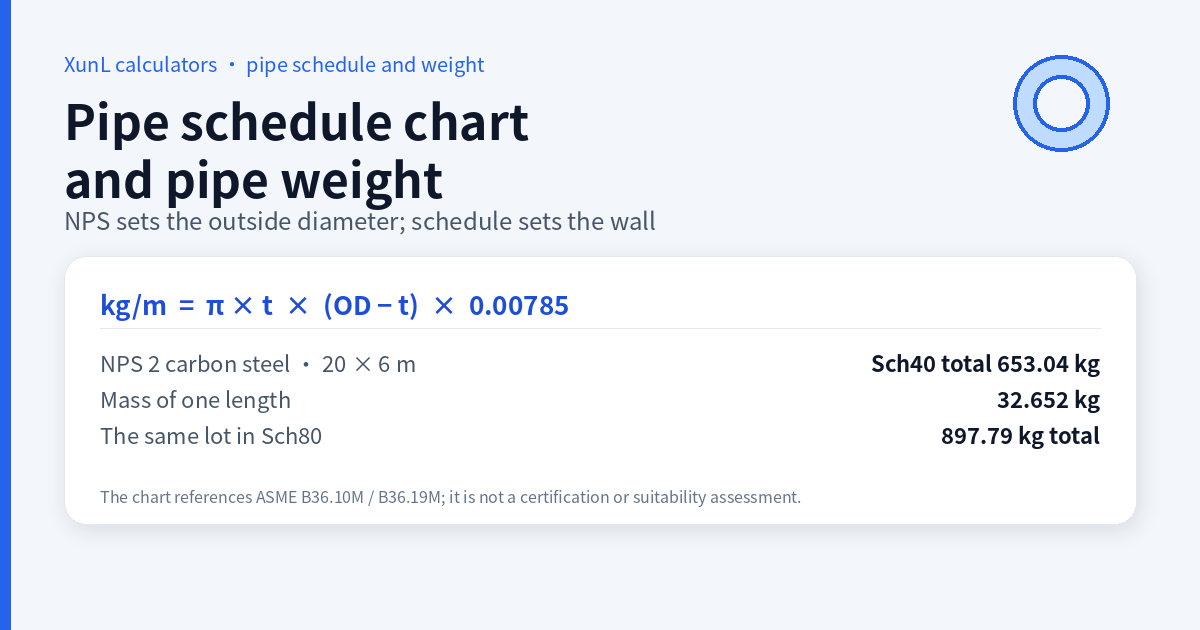
The worked example below is the same one shown on the pipe schedule and weight chart, and it was rechecked on 17 November 2026 against the default inputs of the pipe weight calculator. The chart states that its outside diameters and walls reference ASME B36.10M (carbon and alloy steel) and ASME B36.19M (the stainless S schedules); combinations those standards do not list are not interpolated by the tool. This article only rechecked the figures the calculator and chart displayed for the default example. That is not a line-by-line certification of the table, and it is not advice on pressure rating or whether a pipe is suitable for a duty. The kg/m column on the chart always uses a carbon-steel nominal density of 7850 kg/m³; to use 304 or another grade, change the density in the pipe weight calculator. Settle delivered mass on the supplier’s measured figure or the method named in the contract.
Reading the pipe schedule chart: NPS 2, Sch40
The chart states that NPS 2, Schedule 40 has an outside diameter of 2.375 in (60.325 mm) and a wall of 0.154 in (3.9116 mm). Nominal inside diameter:
ID = OD − 2t = 2.375 − 2 × 0.154 = 2.067 in = 52.5018 mm
Carbon-steel nominal mass matches the formula printed on the page:
kg/m = π × t(mm) × [OD(mm) − t(mm)] × 0.00785
That is the annular area π(OD−t)t times 7.85 g/cm³, divided by 1000. It evaluates to about 5.44197 kg/m, and the page shows 5.442 kg/m.
The pipe weight calculator opens on carbon steel, NPS 2, Sch 40, 6 m, 20 lengths. The totals use the unrounded rate; do not reconstruct them by multiplying the rounded kg/m figure:
- One 6 m length ≈ 5.44197 × 6 ≈ 32.6518 kg (the page shows 32.652 kg)
- Twenty lengths ≈ 653.037 kg (the page shows 653.04 kg)
- Length per tonne ≈ 183.8 m
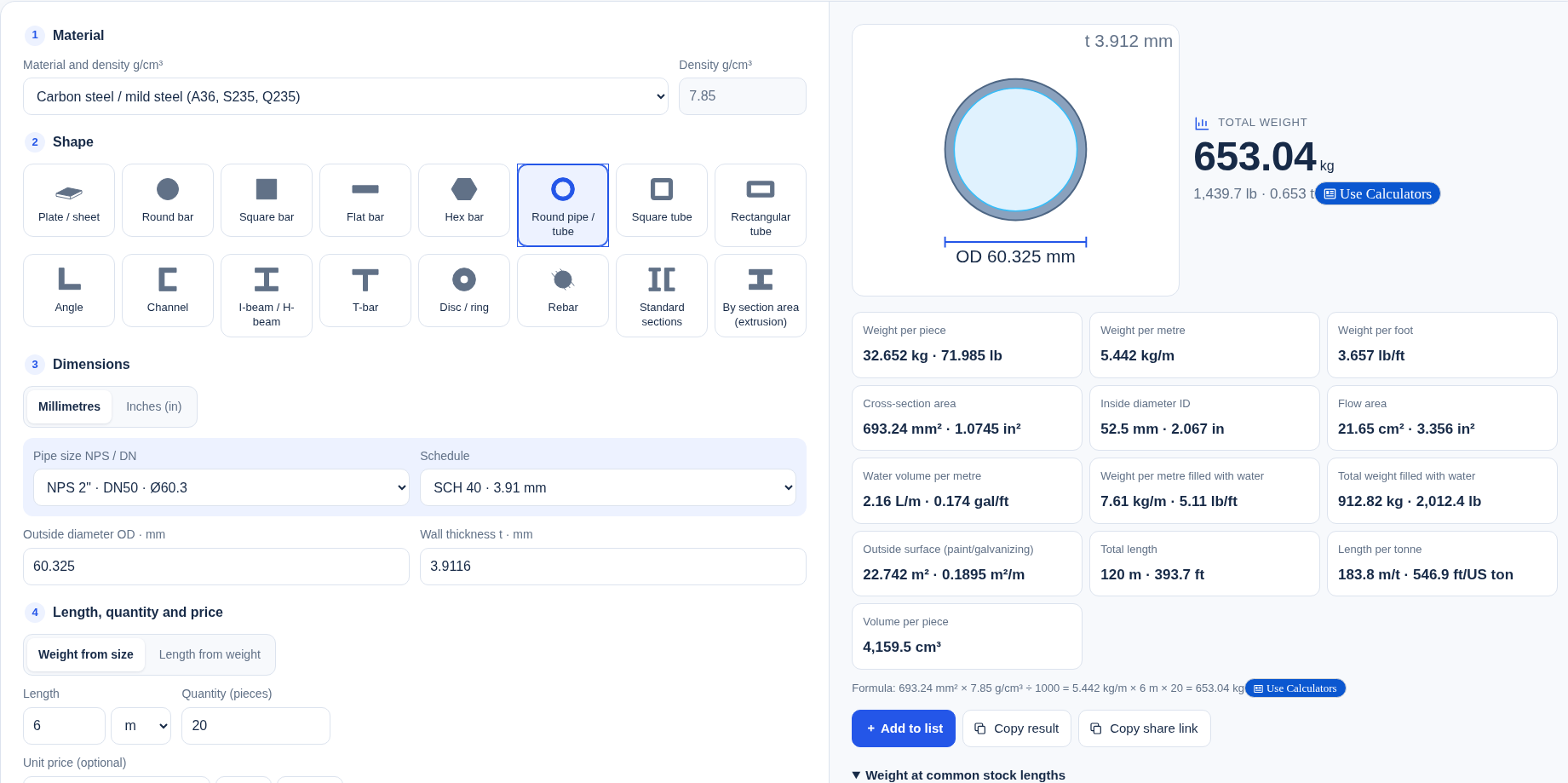
The calculator also reports inside diameter, water volume per metre and water-filled mass (taking water as 1 kg/L): about 2.165 L/m and 7.61 kg/m filled for NPS 2 Sch40. The same 20 × 6 m lot would be about 913 kg if every pipe were full of water. That is a filled mass, not the dry delivered mass.
The same NPS 2, Schedule 80
The outside diameter is still 2.375 in. Schedule 80 has a wall of 0.218 in (5.5372 mm), an inside diameter of 1.939 in (49.251 mm), and an unrounded mass of about 7.48158 kg/m, shown as 7.482 kg/m. The same 20 × 6 m lengths, using that unrounded rate, come to about 897.790 kg, shown as 897.79 kg. Multiplying the displayed 7.482 × 120 gives 897.84, which is not the total on the page. That lot is about 37% heavier than Sch40. A line that only says “twenty 6 m lengths of 2-inch pipe”, with no schedule, does not distinguish these two lots.
STD matches Sch40, and XS matches Sch80, on many sizes (including NPS 2), but not on every size. Use the row in the table.
NPS 2 is listed as DN 50, but the outside diameter is 60.325 mm, not 50 mm and not 2 × 25.4 = 50.8 mm. Treating “2 inch” or “DN50” as the outside diameter understates the mass. The gap is even clearer on smaller sizes: NPS 1/2 has an OD of 0.84 in (21.34 mm), not 15 mm or 12.7 mm.
The chart can be filtered by NPS, schedule or STD/XS/XXS, and the current filter can be downloaded as CSV. The calculated ID is OD−2t. It does not subtract a corrosion allowance or thread height, so it is not a bore after machining or a net flow area for a worn pipe.
When to use the schedule chart or the pipe weight calculator
- The pipe schedule chart lists 377 wall combinations for NPS 1/8–40, with filters and CSV export, and shows OD, wall, calculated ID and carbon-steel kg/m and lb/ft in both inches and millimetres. Use it to look up the dimensions the chart lists for that NPS and schedule.
- The pipe weight calculator pulls OD and wall from the same table, then applies length and quantity. You can switch the material, for example to 304 (7.93 g/cm³). NPS 2 Sch40 in 304 is about 5.49743 kg/m unrounded, shown as 5.497 kg/m; 20 × 6 m using the unrounded rate is about 659.692 kg, shown as 659.69 kg. That figure will not appear in the chart’s kg/m column, which stays on 7.85.
If the tube is not an NPS series — a seamless or hydraulic tube specified by measured OD and wall — use the metal weight calculator “pipe” shape and type the diameters yourself, rather than forcing a nearby schedule.
Round bar, plate, rebar and IPE sections are covered in theoretical steel weight. Kerf and offcuts when a 6 m length is cut into shorts are already described in the stock-cutting article; this page stays on geometry and mass per metre.
Put this guide to work for your business
Start free tools with Google or an email code. Create a company and compare Pro plans when you need monitoring and team permissions.
Personal accounts use Free limits. A separate new company receives a 7-day Pro trial, excluding paid monthly credits.