The short answer
Express couriers and air freight carriers bill on chargeable weight:
- Volumetric weight (kg) = length (cm) × width (cm) × height (cm) ÷ divisor
- Chargeable weight = the higher of actual gross weight and volumetric weight
A light but bulky carton is billed on its volume; a small, dense one on its actual weight. To skip the arithmetic, open the volumetric weight and CBM calculator and enter the dimensions and weight.
Which divisor: 5000 or 6000?
The carrier sets the divisor. Two are common:
| Service | Typical divisor | 1 m³ counts as |
|---|---|---|
| International express (DHL, FedEx, UPS) | 5000 | 200 kg |
| General international air cargo | 6000 | about 167 kg |
DHL states that most international express shipments use L × W × H (cm) ÷ 5000 and are charged on the greater of actual and volumetric weight. Air freight forwarders usually quote with 6000. A smaller divisor gives a higher volumetric weight, so the same carton costs about 20% more at 5000 than at 6000. Always check your rate card; negotiated contracts sometimes use a different factor.
Worked example
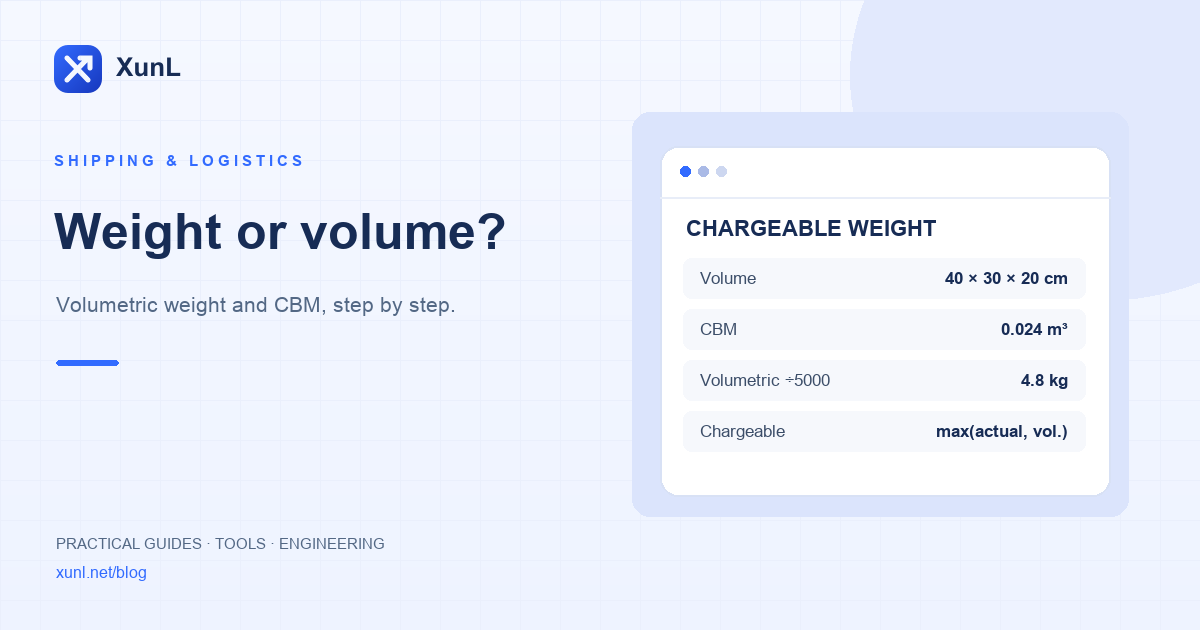
One carton, 40 × 30 × 20 cm, gross weight 3 kg:
- Volume = 40 × 30 × 20 = 24,000 cm³ = 0.024 m³ (CBM)
- At 5000: 24,000 ÷ 5000 = 4.8 kg
- At 6000: 24,000 ÷ 6000 = 4.0 kg
- Chargeable weight: 4.8 kg by express, 4.0 kg by air cargo (both above the 3 kg actual weight)
How to calculate CBM
CBM (cubic meters) is the unit for sea freight and container planning:
- CBM = length (m) × width (m) × height (m) × number of cartons
- From centimeters: L × W × H ÷ 1,000,000
- 1 m³ ≈ 35.315 cubic feet
Less-than-container (LCL) sea freight is usually charged weight-or-measure (W/M): one cubic meter is compared with one metric ton and the larger figure is billed. For full containers, estimate how many cartons fit in a 20GP, 40GP or 40HQ with the container loading calculator, or use the pallet and container fill calculator for palletized cargo.
Multiple cartons and rounding
- Per piece or per shipment: some carriers calculate and round each piece, then add them up; others total the shipment first. Your contract says which.
- Rounding: chargeable weight is often rounded up to the next 0.5 kg or 1 kg, and minimum charges vary by carrier.
- Measure the outermost points, including bulges and handles. Under-declared dimensions get re-measured at the hub and re-billed.
The calculator handles multiple cartons, inches and pounds, custom divisors and rounding rules, and exports a per-carton breakdown.
How to lower chargeable weight
- Fit the box to the product instead of using the next standard size up.
- Ship knock-down or nested where the product allows it, for example packing a fan impeller separately from its housing.
- Move bulky cargo to sea or road when volumetric weight is far above actual weight.
- Price the whole landed cost before quoting: compare FOB, CIF and DDP with the landed cost calculator.
Source
Tools for your next step
Put this guide to work for your business
Create a company account to try website monitoring and the inquiry workbench. Compare Pro plans for your team’s ongoing needs.
No card required. The trial returns to Free when it ends. Paid monthly credits are not included in the trial.