What landed cost includes
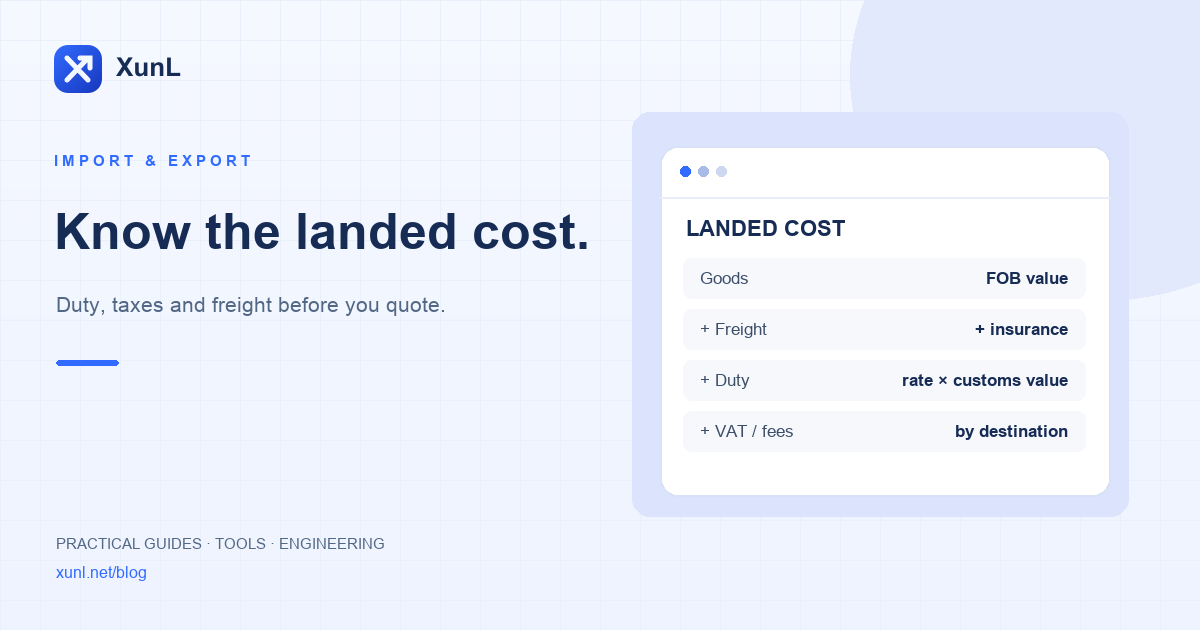
Landed cost is everything it takes to get goods into the buyer's warehouse:
- Goods value: ex-works or FOB price
- International transport: sea, air or express freight, plus insurance
- Duty: customs value × duty rate, plus any anti-dumping, countervailing or additional duties
- Import taxes: for example EU import VAT
- Other charges: customs brokerage, port and terminal fees, storage, delivery to the warehouse
- Money costs: exchange rates and payment fees
On an FOB quote the buyer carries items 2 to 6. On a DDP quote they are all inside your price, and one wrong line eats the margin.
Duty = customs value × duty rate
The rate depends on the product's HS code and its origin; one digit can change the rate completely.
The customs value base differs by country, and this is where most estimates go wrong:
- United States, Canada, Australia: based on the transaction value excluding international freight and insurance (close to FOB). On a CIF invoice, documented actual international freight and insurance included in the price may be excluded; applicable valuation additions such as assists, packing or royalties must still be checked.
- European Union and most other countries: CIF, so freight and insurance to the point of entry are part of the customs value.
Worked example
A shipment with an FOB value of USD 10,000, sea freight USD 1,200 and insurance USD 30. The rates below are for illustration only: 5% duty, 20% import VAT.
EU basis
- Customs value (CIF) = 10,000 + 1,200 + 30 = 11,230
- Duty = 11,230 × 5% = 561.50
- VAT base = 11,230 + 561.50 = 11,791.50 in this example, assuming there are no other amounts to add. EU import VAT also includes applicable taxes and incidental costs not already in customs value, including transport and insurance to the first destination in the importing EU country and to another EU destination if known at importation.
- VAT = 11,791.50 × 20% = 2,358.30
- Total = 11,230 + 561.50 + 2,358.30 = 14,149.80 of illustrative cash outlay before any additional clearance or inland-delivery costs and their effect on the VAT base. Recalculate VAT when these amounts apply. Import VAT may be deductible subject to the importer’s eligibility and applicable conditions, so cash paid and net economic cost can differ.
US basis
- Customs value (excluding international freight and insurance) = 10,000
- Duty = 10,000 × 5% = 500
- At the same rate, US duty is USD 61.50 lower than the EU figure. The US also charges fees such as the Merchandise Processing Fee and Harbor Maintenance Fee, and goods of Chinese origin may face additional duties such as Section 301 tariffs. Rates change often, so check the current HTS and CBP notices.
Where to look up rates
- United States: USITC Harmonized Tariff Schedule
- European Union: TARIC database
If the classification is unclear, confirm it with the importer's customs broker or request a binding ruling.
Calculate it
- Import duty and landed cost calculator: enter goods value, freight, duty, anti-dumping duty and target margin to get total landed cost and a break-even selling price.
- Landed cost and export quote calculator: compare FOB, CIF and DDP quotes for the same shipment.
- Freight depends on volume and loading, so estimate it first with the volumetric weight and CBM calculator and the container loading calculator.
Source
Tools for your next step
Put this guide to work for your business
Create a company account to try website monitoring and the inquiry workbench. Compare Pro plans for your team’s ongoing needs.
No card required. The trial returns to Free when it ends. Paid monthly credits are not included in the trial.