If a learner says 0.45 is bigger than 0.5 because it has more digits, another rule to memorize will not resolve the misunderstanding. Make the units visible: five tenths is fifty hundredths, so the two numbers can be compared in the same-sized pieces.
Begin with the decimal place-value game, then use fractions and a balance scale for different representations of number and equality. Circle measures and the unit circle are shorter extensions at later stages, not five separate lessons for the same age group. This guide follows the public decimal-game instructions reviewed on 18 November 2026 (Asia/Shanghai). Arithmetic explanations are mathematical predictions, not claims of completed game tests or scores.
Activity 1: build the number before comparing it
Enter Explore, not just Levels. The documented place-value chart uses up/down controls with a block picture and reading that change together.
- Build a number with a nonzero tenths digit and ask what one unit means in the picture.
- Use 0.5 versus 0.45 as the comparison question. Predict first; then inspect the game’s actual statement and representation.
- On paper, write
0.5 = 0.50. Compare tenths first, or express both as hundredths:50/100 > 45/100. - Ask the learner to explain why the extra final zero changed the notation, not the amount.
The mathematical expectation is 0.5>0.45. This is not a transcribed game message. The important evidence is which place differs first, not the number of printed digits. OpenStax’s decimal chapter connects decimal places with fractions whose denominators are powers of ten.
Do not say “zeros never matter”. A trailing zero in 0.50 leaves the value unchanged, but changing 0.5 to 0.05 moves the nonzero digit to a different place and changes the value.
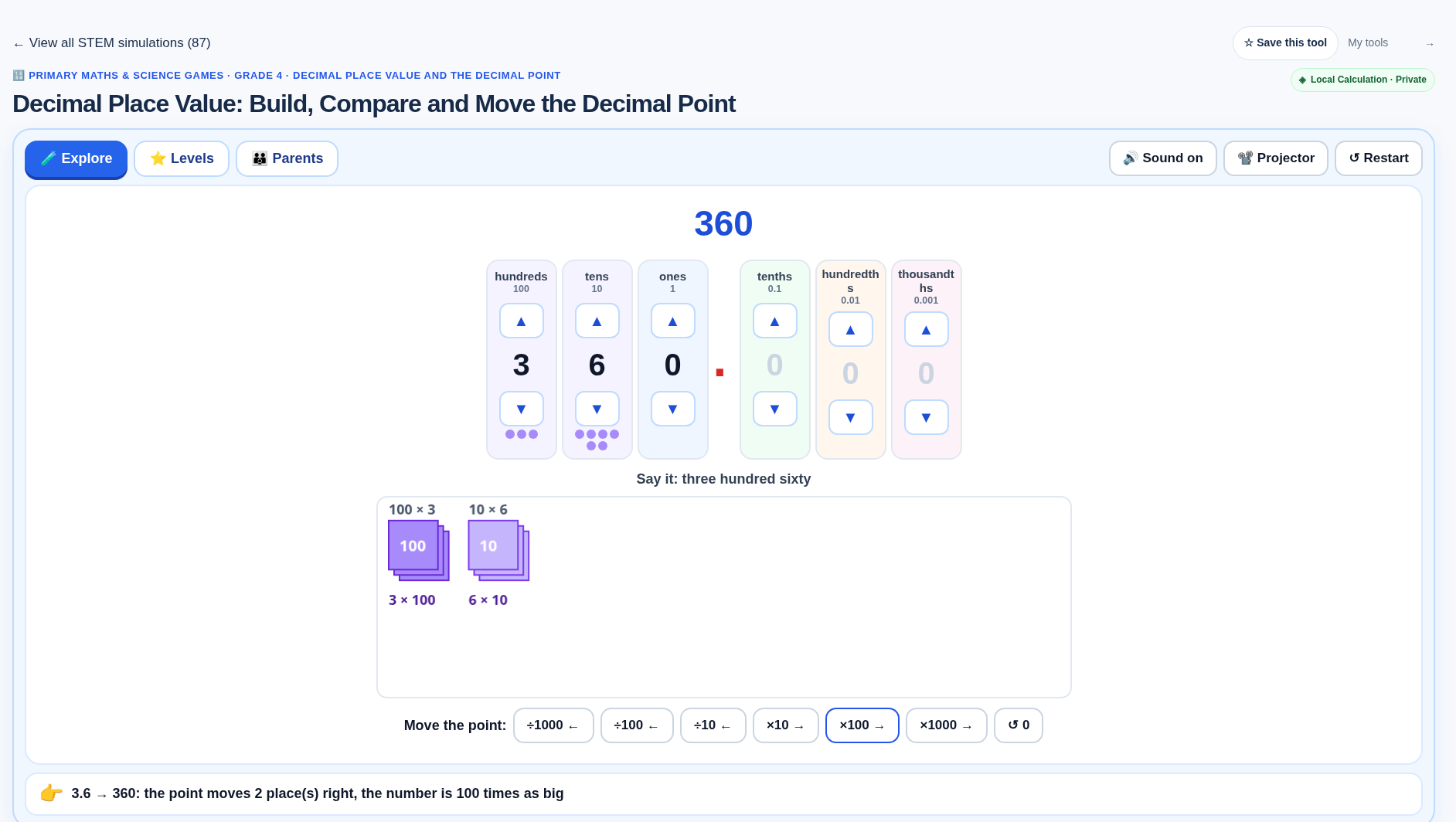
The primary screenshot in this article records the 3.6×100 multiplication in Activity 2, not a 0.5 versus 0.45 comparison. Keep that comparison as the paper prediction above; it is not a measured on-screen comparison statement. No completed level or score is claimed.
Activity 2: explain ×100 through place value
Reset or restart as needed, enter Explore and build 3.6, then select ×100. Keep the paper prediction separate from the observed animation:
3.6 = 3 ones + 6 tenths
3.6 × 100 = 300 + 60 = 360
In the documented chart animation, the decimal point stays in place while digits move to higher-value columns. Each one-place move left makes a digit’s contribution ten times larger; two places produce a factor of one hundred. This explains the operation more clearly than “add two zeros”, which fails for numbers that already have decimal parts.
Then investigate the inverse operation and ask whether the original value returns. Record what happens to every digit’s place, not just where a dot seems to slide. Multiplying by 10 and multiplying by 100 are different numbers of place-value steps.
Recorded on 18 November 2026, 08:07 Asia/Shanghai, in the light theme: after Restart, Explore was opened explicitly. The number after restart was 2.35. Adding 1 one once, adding 1 tenth three times and subtracting 1 hundredth five times produced 3.6 (3 ones, 6 tenths, 0 hundredths). Clicking ×100 settled the main number at 360. The reading was “three hundred sixty”, and the status was “3.6 → 360: the point moves 2 place(s) right, the number is 100 times as big.” The chart showed 3 hundreds, 6 tens, 0 ones, and zeros in the decimal places. No level score was claimed. The inverse operation was not recorded in this run and remains a suggested activity, not a measured result.
Check understanding: “Why does 3 become 300 in the product?” A learner should mention a change from ones to hundreds, not simply a change in the length of the written number.
Activity 3: fractions need equal-sized units too
The fraction grid visualizer is a lab with presets and metric cards, not the same Explore/Levels game interface.
Use its common-denominator 1/2 + 1/3 preset as a question to investigate. Before reading a result, draw one unit rectangle, partition it into sixths and explain:
1/2 + 1/3 = 3/6 + 2/6 = 5/6
This is a paper derivation, not an assertion that the live metric has already displayed it. Adding numerators and denominators directly would count unequal pieces as though they were equal. Keep the same whole when comparing the pictures; half of a large rectangle and a third of a smaller one do not directly settle a fraction-of-one-unit comparison.
For the multiplication area model, distinguish the overlap region from adding two shaded regions. Record the selected operation with any simplified fraction, common denominator and decimal output. A rounded decimal representation is not the definition of an exact fraction.
A supplemental check was made on the Chinese public page only, with no extra screenshot. After Reset, the 1/2+1/3 common-denominator preset was selected: a=1, b=2, c=1, d=3, operation=1 (addition). The live result was 5/6, LCM=6, the decimal card showed 0.833, and the mixed form was 5/6. The derivation line displayed “1/2 + 1/3 = 5/6 = 5/6 = 0.8333”. The decimal card (0.833) and the derivation (0.8333) use different displayed precision; both are recorded as shown.
Activity 4: an equation stays equal because both sides change together
Open the equation-balance game in Explore. Its x boxes and weights model simple unknown-number equations. This is not a chemical-equation balancer.
A separate paper example is 2x+3=11: subtract 3 from both sides to get 2x=8, then divide both sides by 2 to obtain x=4. Substitute into the starting equation to check. These are original mathematical steps, not a claimed completed game scene.
Use the documented Do it to both sides action to investigate an actual balanced setup. Predict whether the scale remains level, then compare with removing weight from only one pan. The principle is preserving equality, not moving a symbol across a page and mysteriously changing its sign.
Division must be by a nonzero number. Multiplying both sides by zero can preserve a true equality but destroys information needed to reverse the step, so it is not a useful general solving move. Keep that reversibility distinction separate from the visual balance analogy.
This supplemental check was also made on the Chinese public page only, with no extra screenshot. After Restart, Explore was opened explicitly. The starting equation was 2x+3=11, and the interface showed “平衡:左边 = 右边”. Clicking “两边各拿走 1” produced 2x+2=10; the interface still showed “平衡:左边 = 右边”. No level completion or score was claimed.
Two brief extensions, not another course squeezed into one game
Circle measurements: the circle circumference and area game separates rolling one turn from counting square units. Ask which measures length and which measures area. Its readings use π≈3.14, an approximation, not an exact definition of π. Keep radius and diameter distinct in C=2πr=πd and use square units for A=πr². A ring is outer area minus inner area, π(R²−r²), not π(R−r)². These are mathematical relations, not a record of a particular radius being tested.
Later trigonometry: the unit-circle and trig-wave visualizer belongs after the relevant angle and coordinate concepts. At its documented 60° preset, compare the point’s horizontal and vertical projections with the cosine and sine labels. Keep degrees and radians distinct; the general conversion is radians=degrees×π/180. In the displayed form y=A sin(ωx+φ), amplitude, angular coefficient and phase have different roles; for nonzero ω the period is 2π/|ω|. It is not necessary for a child learning tenths to master that extension immediately.
These supplemental checks were made on the Chinese public pages only, with no extra screenshots.
Unit circle: after Reset, the preset “第一象限经典 60° (π/3)” was selected, with θ=60°, A=1, ω=1, φ=0 and trig lines=1. The metric cards showed sin(θ)=0.87, cos(θ)=0.5, 1.05 rad, and a period card reading “6.28 rad”. The derivation separately gave sin=0.866, cos=0.5 and T=6.28s. The period is labelled in radians on the card and in seconds in the derivation; both are recorded as displayed, without inferring a correction.
Circle area: after Restart, Explore and the area mode were opened. Radius r=4 cm, diameter=8 cm, circumference=25.12 cm, and the formula area=50.24 cm². The grid estimate was 32 complete squares plus 28 cut squares, about 46 cm²; the page says to count each cut square as about half. The grid estimate differs from the formula result. No level or score was claimed.
Questions that reveal a misconception
Are 0.5 and 0.50 equal? Yes, for number value. Ask the learner to show equal tenths/hundredths rather than rely on digit count.
Does multiplication always make a number bigger? No. Positive multiplication by a factor below one is a useful later counterexample. The ×10/×100 activity describes those particular factors, not every multiplication.
Does getting a game answer right prove understanding? Not by itself. Ask for a unit, a drawing and an explanation of the operation. The pages’ grade/textbook framing is instructional context, not curriculum certification. No play history or level score is asserted here; local-processing statements also do not establish a network audit or site-wide absence of ads.
Put this guide to work for your business
Start free tools with Google or an email code. Create a company and compare Pro plans when you need monitoring and team permissions.
Personal accounts use Free limits. A separate new company receives a 7-day Pro trial, excluding paid monthly credits.