An IBAN checker answers a narrow question: does this account-number string fit the supported national format and pass its checksum? It does not tell you whether the account exists, belongs to your supplier or can receive your payment. Use the IBAN checker to catch formatting problems, not to approve a beneficiary.
This guide is based on the checker’s public documentation reviewed on 18 November 2026 (Asia/Shanghai), and Swift’s explanation of the IBAN standard and registry. The example below is a public registry example reproduced on the tool page, not a customer account supplied for this article.
What an IBAN contains
An IBAN begins with a two-letter country code and two check digits, followed by the country-specific Basic Bank Account Number (BBAN). ISO 13616 defines the IBAN structure. Swift is the registration authority for national IBAN formats; its registry describes their technical specifications. The number of characters and the letter/digit positions depend on the country.
The checker documents the following snapshot—not a claim that this article has independently established the latest registry release:
| Country | Total characters, excluding spaces | BBAN structure documented by the tool |
|---|---|---|
| Germany, DE | 22 | 8 bank-code digits + 10 account digits |
| United Kingdom, GB | 22 | 4 bank letters + 6 sort-code digits + 8 account digits |
| France, FR | 27 | 5 bank digits + 5 branch digits + 11 alphanumeric characters + 2 key digits |
A country’s fixed length is not interchangeable with another country’s. Two countries can share a length while requiring different character positions. Passing a bank-code shape check does not mean the bank code was found in a current bank directory.
How to check a supplied number
- Obtain the complete IBAN from the beneficiary’s trusted banking instructions, not an inferred number assembled from fragments.
- Open the checker and paste the complete value. Its documentation says spaces are removed and lowercase ASCII letters become uppercase.
- Choose Calculate. Read country, length, structure and checksum feedback rather than treating any single number as the whole result.
- If it fails, compare it with the original instructions. Do not change check digits until it passes: that would create a different string, not verify the one you were given.
- If it passes, continue beneficiary and payment checks through your bank and trusted business channels.
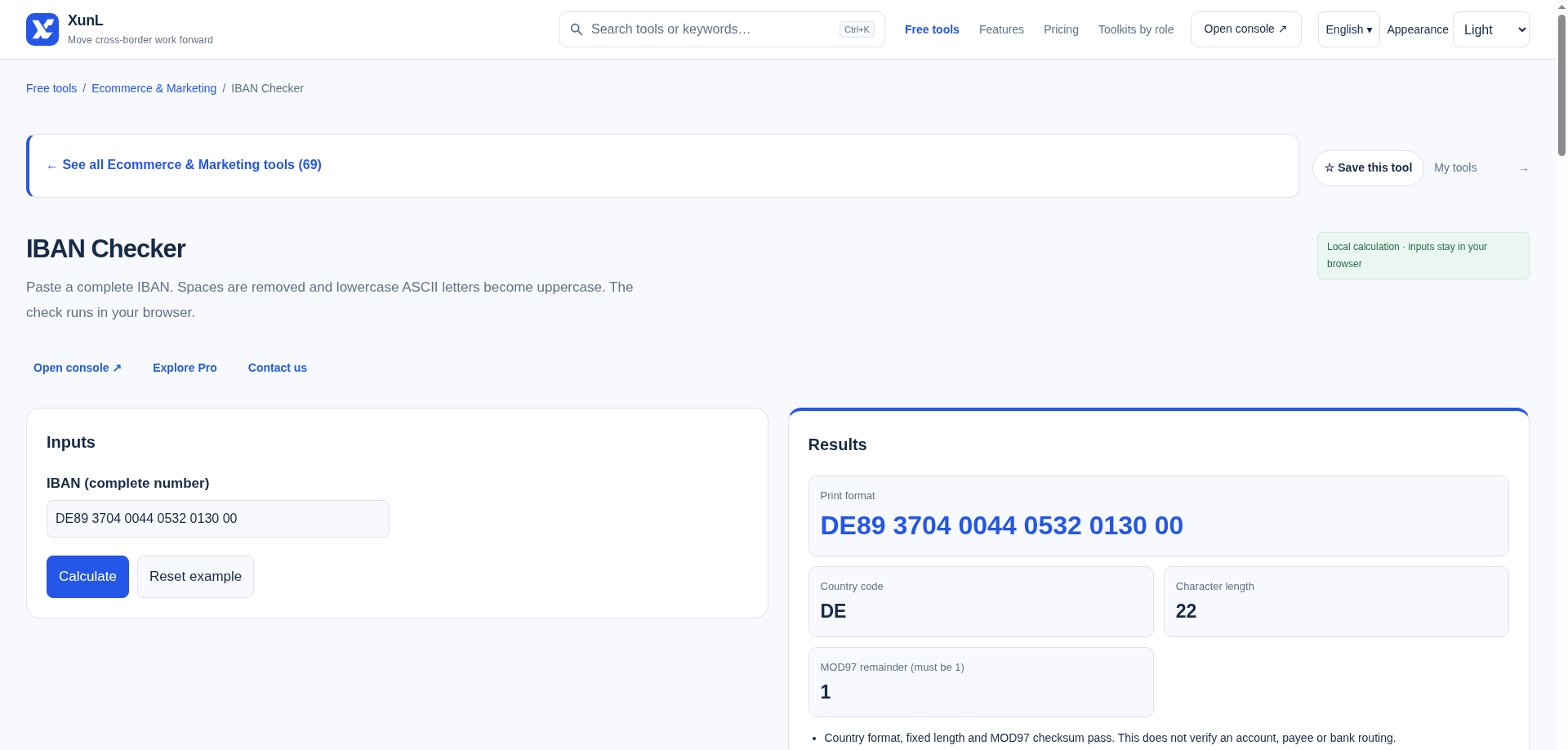
Use the public example below when learning the interface. Do not use it as a payment destination or treat it as an account assigned to you.
The captured run entered DE89 3704 0044 0532 0130 00 and selected Calculate in each language. Results showed country DE, length 22 and MOD97 remainder 1. The English statement was “Country format, fixed length and MOD97 checksum pass. This does not verify an account, payee or bank routing.”
MOD 97-10, step by step
The tool page publishes this example: DE89 3704 0044 0532 0130 00, a 22-character German IBAN with MOD97 remainder 1. The captured calculation above matches those documented example values.
To understand the checksum:
- Remove display spaces:
DE89370400440532013000. - Move the first four characters to the end:
370400440532013000DE89. - Expand letters using
A=10throughZ=35; hereD=13,E=14, giving370400440532013000131489. - Divide that integer string by 97 and take the remainder. The checksum condition is remainder 1, alongside the separate country, length and structure checks.
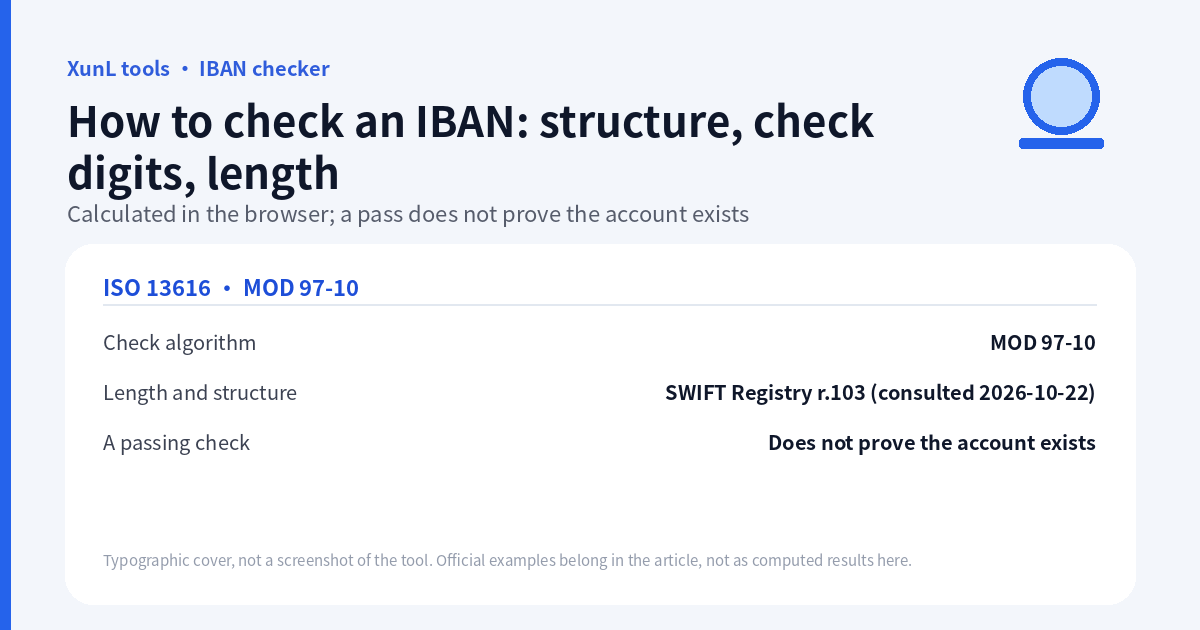
This is the ISO 7064 MOD 97-10 method described on the tool page. Software can calculate it digit by digit using remainder = (remainder × 10 + next_digit) mod 97; it need not convert the entire expanded string to an ordinary floating-point number. A checksum is an error-detection mechanism, not encryption or proof of ownership.
In a separate English-page check, the worker changed DE89 to DE99, leaving the rest unchanged: DE99 3704 0044 0532 0130 00. The exact alert was “The IBAN checksum failed. Check the original number.” This is one recorded typo example, not a universal detection-rate claim.
What “passes” cannot establish
The checker’s limits explicitly exclude:
- Whether the account was opened, is active or can receive a particular payment.
- Whether the account belongs to the named beneficiary.
- Whether a supplied BIC/SWIFT code is correct.
- Additional domestic checksum rules beyond the checks documented by the tool.
Its documented format data is SWIFT IBAN Registry Release 103, dated September 2026 and consulted by the tool on 22 October 2026. It rejects country codes absent from that snapshot. An unsupported result should prompt a check of current official bank instructions and the registry, not a conclusion that an otherwise documented account is fraudulent.
An IBAN and a BIC serve different identification purposes. This tool does not establish that a bank-account/BIC pair is correct, and this guide does not prescribe the fields required for every transfer route. Follow the sending bank’s instructions.
A pass is not approval to pay
For a new beneficiary, or a request to replace bank details, independently confirm the instructions with a known contact through an established channel. Do not rely only on the contact details included in the change request. This is a practical separation of checks: a plausible number is not evidence that the message author is entitled to receive money.
For the broader counterparty workflow, see how to verify an overseas buyer or inquiry. For document reconciliation, use the commercial invoice and packing-list consistency guide. Neither process turns a checksum result into a bank guarantee.
Privacy and troubleshooting
The page says calculation happens in the browser and inputs are not uploaded to a calculation server; it also says existing analytics and advertising still load. That is narrower than “the whole site is offline” or an independent security audit. Use public examples for screenshots, remove account details from support messages, and consider the sensitivity of any copied or downloaded result.
If a number fails, look first for missing characters, O versus 0, or a mismatch with the national format. Re-copy from the original bank-issued instructions when possible rather than guessing. If a bank rejects a number that this checker accepts, let the bank resolve account status, route requirements and any domestic rules: those are outside this checker’s documented scope.
Put this guide to work for your business
Start free tools with Google or an email code. Create a company and compare Pro plans when you need monitoring and team permissions.
Personal accounts use Free limits. A separate new company receives a 7-day Pro trial, excluding paid monthly credits.