Why translating a whole page can break more than the wording
A product page combines visible copy, descriptive attributes, markup, links and business identifiers. Those elements do not all need the same treatment. Rewriting the source as ordinary prose can produce fluent language while changing a model number, breaking a placeholder or losing a destination link.
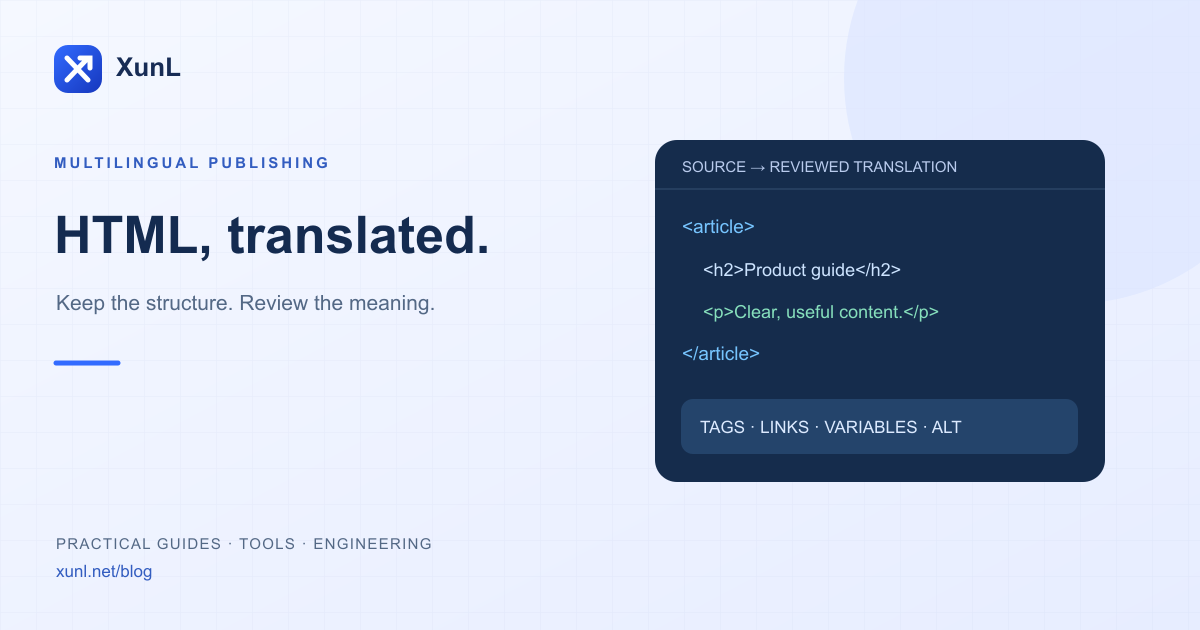
XunL HTML and text translation offers a separate HTML mode. It uses Google Cloud Translation NMT and checks structural and protected content. It does not ask Gemini to invent new product facts. Free single requests and paid batch work have separate limits; review the current settings before submitting.
Identify what should remain unchanged
Prepare a short list of protected brands, series, model numbers, terms and template variables. A translation task should not fill gaps in certifications, dimensions or performance claims.
This is a fictional source example:
<article>
  <h2>{{product_name}}</h2>
  <p>Model LW-DEMO-01 is available for project review.</p>
  <a href="https://shop.example/products/demo">View specifications</a>
  <img src="/images/demo.jpg" alt="Front view of the sample unit">
</article>
Check LW-DEMO-01, {{product_name}}, the link destination and image path separately. Decide whether the heading, paragraph, link label and ALT should be translated. The sample domain and identifiers are not real product promises.
Structural integrity is not a language-quality verdict
Preserving tags and placeholders helps detect structural failures. It does not prove that the translation preserves every commercial condition. Matching digits also do not establish correct units, negations, limits or payment terms.
| Review area | What to verify |
|---|---|
| Markup | Valid hierarchy and readable page structure |
| Links and images | Stable addresses and appropriate language destinations |
| Identifiers | Models and terms match approved specifications |
| Numbers | Values, ranges, units, dates and amounts are accurate |
| Descriptive attributes | ALT and labels explain the actual content |
| Commercial meaning | Restrictions, lead times and commitments remain correct |
The HTML formatter can make source review easier. Readable indentation is useful, but it is not evidence that the underlying product information is correct.
Choose attributes intentionally
ALT should describe the image rather than carry a keyword list. Titles, accessibility labels and descriptions should suit the actual element and page. Review the selected attribute options before submission and compare the translated result afterward.
Google documents HTML input behavior in its Cloud Translation text guide. HTML support does not validate an entire CMS template, script behavior or every business variable. Keep application logic outside the text that should change.
Configure the language pages after translation
Translated copy is only one part of multilingual publishing. Each version needs a stable public URL and a language declaration appropriate to its content. Review canonical destinations and language relationships as part of the CMS release.
Use hreflang for actual equivalent versions and maintain reciprocal links. Do not pair a translated article with an unrelated language homepage or a draft that is not public. See Google’s localized-version documentation.
If internal links and product images need different language destinations, review those choices in your publishing process. A translation API cannot make every CMS decision for you.
Plan batch work around actual content
Test representative HTML before submitting a larger set. Long articles, target languages and selected attributes affect upstream input. A count of articles alone cannot describe the total work or cost.
XunL batch HTML translation requires active paid membership and a confirmed credit reservation. Item count, characters and language copies have separate limits. Successful work is settled against actual metering. Download the results within the stated retention period and keep your publication records.
A simple release register can track the source URL, target language, task ID, review notes, final URL and publication date. For important products, use one verified specification source across all languages.
A final publishing pass
- Check structure, mobile rendering and images on a test page.
- Compare identifiers, numbers, units and conditions with original records.
- Test the key product links and inquiry path.
- Verify canonical and actual translated counterparts.
- Recheck the public page and retain a revision record.
Start with HTML translation, use the Markdown editor for handoffs, and run website diagnostics after publishing.
Prepared with AI assistance and checked against XunL’s current workflow and the linked official documentation. Sample products, domains and identifiers are fictional. Translation still needs review against real business material.
Tools for your next step
Put this guide to work for your business
Create a company account to try website monitoring and the inquiry workbench. Compare Pro plans for your team’s ongoing needs.
No card required. The trial returns to Free when it ends. Paid monthly credits are not included in the trial.